
Wine does not have to be intimidating.
It does not have to be reserved for fine dining, luxury restaurants, or people who know every grape variety by heart.
Sometimes wine is simply something cold, delicious, affordable, and refreshing that makes local food taste even better.
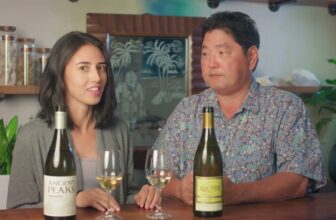
In this episode of Chuck Furuya Uncorked, Chuck and Kali are joined by McKenna Maduli, host of Talk Story, for a Fine Wines and Local Grinds session built around two simple food-and-wine pairings:
- Buzz’s Steakhouse calamari with Skouras Zoe, a Greek white wine made from Roditis and Moschofilero.
- Zia’s stracciatella / caprese-style salad with Birichino Malvasia Bianca from California.
The larger point is not to prove a perfect pairing.
The point is to show that good wine can be fun, affordable, local-food friendly, and easy to enjoy.
Who Is McKenna Maduli?
McKenna Maduli is introduced as the host of Talk Story, a Hawaii variety show created to highlight the talented people who come from Hawaii.
After years living in Los Angeles, she returned home and built a platform for local athletes, musicians, entertainers, cultural figures, and creative people.
That background makes her a perfect guest for this episode.
She is curious, funny, direct, and honest about the way many people feel when they first approach wine.
Wine can seem scary.
Wine stores can feel overwhelming.
A wall of bottles can make someone think:
Where do I even start?
That is exactly why this episode works.
It brings wine back down to earth.
Wine and Food as a Way of Life
Chuck begins with a simple observation.
In many Mediterranean cafés, beachside bistros, and countryside restaurants, people do not sit around swirling wine and analyzing it for half an hour.
They eat.
They drink.
The wine washes down the food.
It is part of the meal and part of the rhythm of life.
That is the kind of experience Chuck wants to share.
Wine and food pairing should not be about pressure. It should not be about showing off. It should be about enjoyment.
If the pairing works for you, great.
If it does not, that is fine too.
The goal is to explore.
Why Local Grinds Work with Wine
McKenna says that before talking with Chuck, she never really thought about pairing wine with poke, Hawaiian food, or local dishes.
That reaction is common.
Many people think of Hawaiian food with beer, soda, iced tea, or something familiar like a cold Heineken or Diamond Head strawberry soda.
Wine may not be the first thing that comes to mind.
But local food has exactly the kind of flavor that can make wine exciting:
- salt;
- smoke;
- seafood;
- herbs;
- rich sauces;
- spice;
- fried textures;
- citrus;
- umami;
- and freshness.
The right wine does not need to be expensive.
It just needs to fit the food.
Chuck’s Service Philosophy
One of the most useful parts of the conversation is Chuck’s philosophy of service.
When a guest asks for help, he does not simply tell them what to drink.
He asks:
What wine do you normally drink?
That one question gives him a lot of information.
It can reveal whether someone likes:
- white, red, rosé, or sparkling;
- dry or sweet;
- full-bodied or light-bodied;
- oaky or unoaked;
- familiar or adventurous;
- affordable or expensive.
From there, he can suggest two directions:
- one wine close to what the guest already likes;
- and one wine that may work better with the food.
Then the guest chooses.
That matters because wine service should support people, not talk down to them.
Wine Should Not Be About Intimidation
McKenna talks openly about how intimidating wine can feel.
People worry that they will choose wrong, pronounce something wrong, or look foolish in front of someone who knows more.
This episode pushes against that fear.
Wine does not need to begin with expensive bottles.
It can begin with a $13.99 Greek white wine that tastes great with calamari.
That is a much easier entry point.
And once someone has one good experience, they have a reference point.
They can walk into a store and say:
I liked that light, crisp Greek wine with seafood. What else should I try?
That is how wine confidence grows.
Pairing One: Buzz’s Calamari with Skouras Zoe
The first dish is the famous calamari from Buzz’s Steakhouse in Lanikai.
It is not just basic fried calamari.
It is a calamari steak, panko-crusted and pan-fried, topped with house-made lemon beurre blanc, capers, chopped cilantro, and fresh lemon.
That gives the dish several pairing elements:
- crispy panko;
- tender calamari;
- richness from beurre blanc;
- briny capers;
- herbal cilantro;
- fresh lemon;
- seafood sweetness;
- and fried texture.
This dish needs a wine that can refresh the palate.
It also needs a wine that can work with herbs, lemon, and brine.
The Wine: Skouras Zoe
Chuck pairs the calamari with Skouras Zoe, a Greek white wine from the Peloponnese.
The wine is made from two indigenous Greek grapes:
- Roditis
- Moschofilero
Chuck describes it as a Greek country wine — the kind of wine people would drink with food, not sit around analyzing as a trophy bottle.
It is light, aromatic, crisp, and affordable.
The price is one of the best parts: around $13.99 to $14.99 in store.
That is important because the episode is not about luxury wine. It is about real wine for real food.
Why Zoe Works with Calamari
Zoe works with the calamari in two main ways.
First, its aromatics act like fresh herbs.
That connects beautifully with the cilantro and capers on the dish.
Second, its lemon-lime edge acts like a squeeze of citrus.
That helps cut through:
- fishiness;
- oiliness;
- beurre blanc richness;
- fried coating;
- and seafood intensity.
The wine keeps the palate fresh between bites.
That is the job.
It is not trying to overpower the dish. It is making each bite easier and more enjoyable.
A Wine That Can Replace Seltzer
One of the most practical moments comes when McKenna compares Zoe to the kind of drink someone might bring to a party.
She talks about being a seltzer drinker and realizes that a light, crisp wine like Zoe could fill that same social role.
That is a smart way to think about wine.
Not every bottle has to be heavy or formal.
Some wines are meant to be:
- chilled;
- casual;
- refreshing;
- lower-pressure;
- party-friendly;
- and easy to share.
Zoe fits that lane.
Chuck even says it can be served on the rocks for her taste.
That is not a traditional wine-snob answer.
It is a hospitality answer.
If serving it colder or over ice makes someone enjoy it more, that is the point.
Greek Wine as a Starting Point
The episode also introduces Greek wine as something worth exploring.
Chuck explains that Greece has a huge amount of history, ancient grape varieties, and unique wine culture, but many people still do not know where to begin.
Zoe is a good starting point because it is:
- affordable;
- light;
- crisp;
- aromatic;
- food-friendly;
- and not intimidating.
It gives people a first step into Greek wine without asking them to spend a lot or study a map first.
That is exactly the kind of wine this podcast likes to highlight.
Pairing Two: Zia’s Stracciatella with Birichino Malvasia Bianca
The second dish is from Zia’s in Kaneohe.
It is a take on a caprese-style salad, but instead of standard mozzarella, it uses stracciatella cheese.
The dish includes:
- tomatoes;
- stracciatella;
- basil;
- spinach pesto;
- and a simple, fresh, rich texture.
Stracciatella is soft, creamy, and delicate. The quality of the tomatoes matters. The pesto adds herbal lift.
This dish is richer than the calamari, but still fresh.
So the wine needs both body and brightness.
The Wine: Birichino Malvasia Bianca
Chuck pairs the stracciatella dish with Birichino Malvasia Bianca from California.
Malvasia is an aromatic white grape, and Chuck notes that it was once among the most widely planted white grapes in the world.
In this context, the important thing is not the grape’s history alone.
It is how well this specific wine works with food.
The Birichino Malvasia has enough richness to handle the cheese and enough aromatic lift to connect with the pesto and basil.
It is also affordable, around $13.99 in store.
Again, this matters.
A wine does not have to be expensive to make food taste better.
Why Malvasia Works with Stracciatella
The Birichino Malvasia works because it matches the dish’s balance of richness and freshness.
The cheese needs a wine with enough body.
The tomatoes need brightness.
The pesto needs aromatics.
The basil needs lift.
The wine brings:
- floral aroma;
- gentle richness;
- freshness;
- food-friendly texture;
- and aromatic energy.
It does not flatten the dish.
It keeps it alive.
This is the kind of pairing that feels simple while you are eating it, but makes sense when you break it down.
Enjoyment Over Perfection
McKenna’s takeaway from both pairings is important.
This is not about preparing for a perfect pairing at a fancy dinner.
It is about enjoyment.
The wines are quaffable. They are gulpable. They keep the palate fresh and alive between bites.
You do not need to swirl the glass and analyze every aroma.
You can just eat, drink, talk, laugh, and enjoy the next bite.
That is the real spirit of Fine Wines and Local Grinds.
Affordable Wine Can Still Add a Lot
Both wines are around $13.99.
That is central to the episode.
Chuck is not asking people to break the bank. He is showing that a modest bottle can transform the food experience.
With the calamari, the Zoe adds lift, citrus, and herbal freshness.
With the stracciatella, the Birichino Malvasia adds aromatic depth and balances the cheese.
That is a lot of value for the money.
Good pairing is not always about expensive wine.
It is about choosing the right kind of wine.
Hospitality, Aloha, and Service
The episode also moves into a broader discussion of hospitality.
Chuck talks about the importance of being a team in restaurants and focusing on the guest experience. For him, hospitality is not about the ego of the sommelier, chef, server, or manager.
It is about the customer.
The goal is to deliver:
- good food;
- good wine;
- timeliness;
- value;
- energy;
- and sincere hospitality.
He connects this to aloha.
Aloha is not just a word on a sign. It has to come from inside. The true test is when things are not going perfectly.
If the restaurant is busy, the air conditioning is not working, a flight is delayed, or someone is having a hard day, that is when real hospitality shows.
McKenna’s View of Storytelling
McKenna connects this same idea to her own work in television.
She sees storytelling as a form of hospitality.
The care someone puts into making a cocktail, serving a meal, or guiding a guest can also apply to preparing an interview, researching a guest, and telling someone’s story well.
That is why she and Chuck connect so naturally in the episode.
They are working in different fields, but the core idea is similar:
Take care of people.
Pay attention.
Do the work.
Make people feel seen.
Wine as Connection
Near the end, McKenna reflects on what she has learned from Chuck and the podcast.
Wine is not just about drinking.
It is about connection.
Instead of taking a quick shot or drinking without thinking, wine encourages people to slow down, eat together, talk, compare, and enjoy the moment.
That is one of the strongest themes in the episode.
Wine is not only a beverage.
It can be a reason to gather.
It can be a way to make food more enjoyable.
It can be a way to pass knowledge between generations.
It can be a way to create a moment.
The Big Lesson
This episode works because it shows wine through real life.
The food is local.
The wines are affordable.
The conversation is funny.
The guest is honest.
The goal is not to impress.
The goal is to make wine feel possible.
For someone who normally drinks seltzer, Pinot Grigio, cocktails, or familiar California wines, this episode says:
Try this.
Try a Greek white wine with calamari.
Try Malvasia with tomatoes and cheese.
Do not worry about knowing everything.
Start with what tastes good.
Then keep asking questions.
Final Takeaway
This Fine Wines and Local Grinds episode with McKenna Maduli is a reminder that wine can be casual, affordable, local-food friendly, and deeply enjoyable.
Skouras Zoe works with Buzz’s calamari because its aromatics act like fresh herbs and its lemon-lime edge cuts through seafood, oil, and beurre blanc.
Birichino Malvasia Bianca works with Zia’s stracciatella and caprese-style salad because it has enough richness for the cheese and enough aromatic lift for basil and pesto.
Both wines are around $13.99.
Both wines make the food better.
And both wines show that you do not need a luxury bottle to have a great wine moment.
The biggest lesson is simple:
Wine is not about intimidation.
Wine is about food, conversation, hospitality, discovery, and enjoyment.
FAQ
Who is the guest in this episode?
The guest is McKenna Maduli, host of Talk Story.
What is Talk Story?
Talk Story is a Hawaii variety show created to highlight talented people from Hawaii, including athletes, musicians, entertainers, and cultural figures.
What is the theme of this episode?
The theme is Fine Wines and Local Grinds, focusing on approachable wine pairings with local-style food.
What foods are featured?
The episode features Buzz’s Steakhouse calamari and a stracciatella / caprese-style salad from Zia’s.
What wine is paired with the calamari?
Chuck pairs the calamari with Skouras Zoe, a Greek white wine.
What grapes are in Skouras Zoe?
The wine is made from Greek grapes Roditis and Moschofilero.
Why does Zoe work with calamari?
Its aromatics act like fresh herbs, while its lemon-lime edge cuts through seafood, oiliness, and beurre blanc.
What wine is paired with stracciatella?
Chuck pairs the stracciatella dish with Birichino Malvasia Bianca from California.
Why does Malvasia work with stracciatella?
It has enough richness for the cheese and enough aromatic lift to work with basil, pesto, and tomatoes.
Are the wines expensive?
No. Both wines are discussed as affordable bottles around $13.99.
What does Chuck ask guests when recommending wine?
He asks what wine they normally drink, because that answer gives clues about color, sweetness, body, oak, style, and price range.
What is the biggest lesson from this episode?
The biggest lesson is that wine does not have to be intimidating or expensive. It can be affordable, refreshing, food-friendly, and part of everyday enjoyment.





What makes Skouras Zoe a good choice with calamari? I've always paired my fried seafood with beer.
Skouras Zoe is great with calamari because its crispness and citrus notes help cut through the rich, fried texture. It refreshes the palate between bites, enhancing the overall dining experience.
I agree! I usually go for beer too, but this pairing sounds intriguing.
I had the chance to try the Birichino Malvasia Bianca a few weeks ago with a similar dish, and it was excellent! The creaminess of the stracciatella really complemented the wine's aromatic profile. It made the meal feel special without being pretentious.
That's great to hear! Malvasia is indeed a versatile wine that pairs well with creamy textures like stracciatella.
Sounds delicious! I love creamy cheese, and I remember enjoying a Malvasia before. I'll have to try it with stracciatella next time.
How does Greek wine compare to Italian wines in terms of flavor and price?
I've noticed that too! Italian wines can be a bit pricier. I appreciate finding a good Greek wine without breaking the bank.
Greek wines like Zoe are often lighter and more aromatic compared to many Italian wines. They can also be more affordable, making them a great entry point for casual wine drinkers.